
Approach
High-level thinking, translated into real human behavior and practical action.
Five things that hold
No workshop comes off a shelf.
The design follows the people and the business reality in front of us. An idea has to prove it can be used before it earns a place.
- 01
Bespoke, never off the shelf
Nothing is pulled from a catalogue. The work is built around the client, the people in the room, their level of seniority, the business reality, and what they actually need to be able to do differently afterwards.
- 02
Conceptually serious, never academic for its own sake
Credible theory, models and research sit behind the work. Then they are translated immediately into something people can use. A concept has to lead somewhere: a question, a conversation, an exercise, a decision, a different behavior.
- 03
Reality rather than abstraction
Real negotiations, real tensions, real leadership problems, real people. Participants work on the situations they actually face, not a day spent discussing generic case studies.
- 04
Attuned to what's underneath the words
Confidence, authority, defensiveness, avoidance, trust, power, emotion, cultural differences, who is holding back, who is dominating. That human layer is not a side effect of the work. It is a major part of it.
- 05
Demanding about quality
Everything is refined until the language, the flow, the exercise and the underlying idea make sense together. No filler, no corporate jargon, no material that sounds clever but has no point.
In the room
What that looks like in practice
- We start from what people need to be able to do differently, not from a topic.
- The theory is there to earn its place: it has to change what happens next.
- People practise on their own live situations, with their real constraints in the room.
- What is unsaid is worked with: the hesitation, the hierarchy, the culture of the group.
- Nothing ships until it is clear, useful and free of padding.
Frameworks Alycia developed
Systems built from the work itself
Truthful Transparency™
Proprietary coaching approach
A way of working that drives honest dialogue and permanent behavioral change, turning group dynamics into collective intelligence rather than polite agreement.
The Challenge Wall™
Turning Challenge into Collective Growth
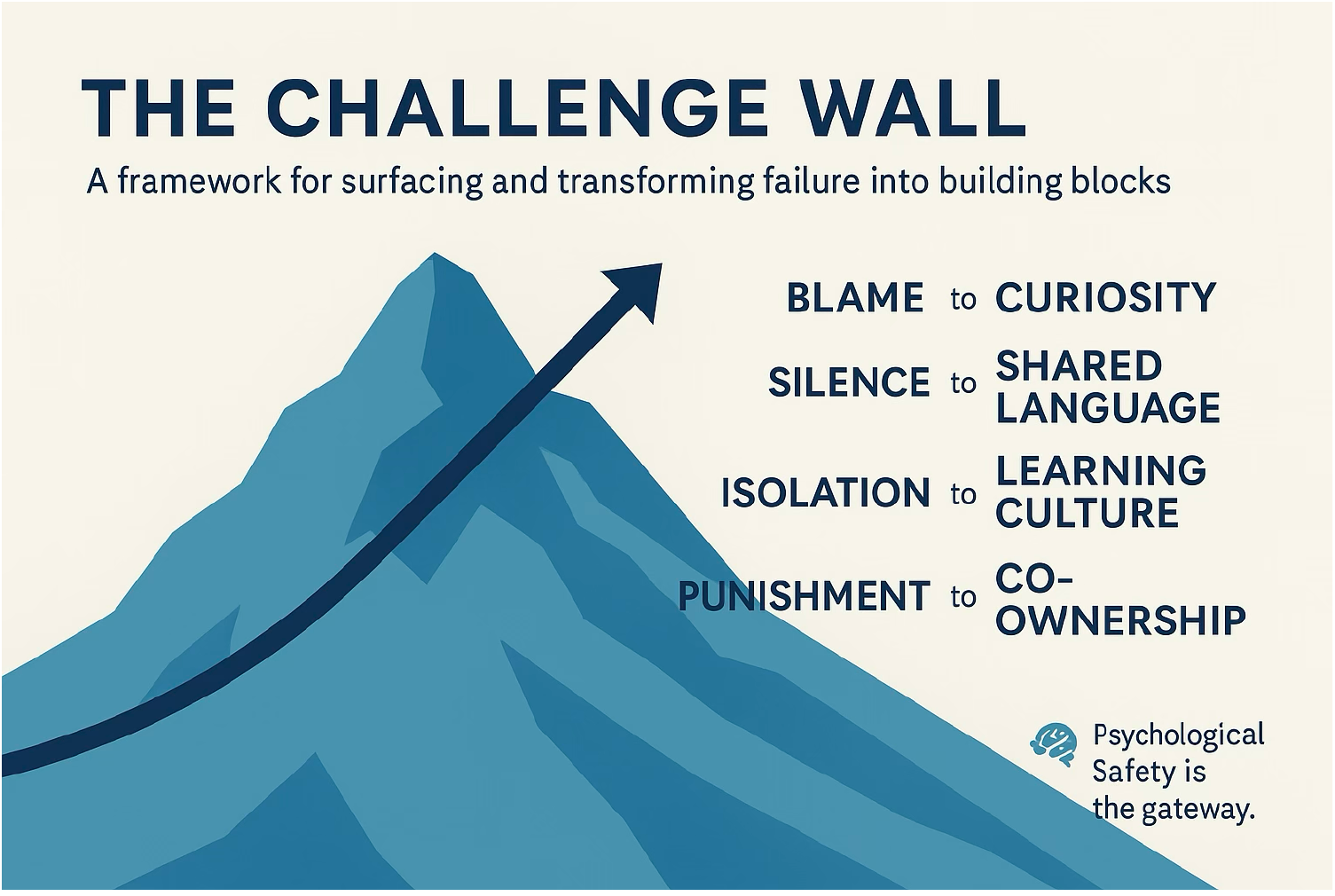
The Challenge Wall™ is a framework built for global teams addressing real challenges without blame, avoidance, or silence. It provides a strategic method for turning difficult conversations into coordinated action, shared ownership, and learning.
- What it is
- A structured team practice for surfacing real challenges, working through them together, and turning them into action.
- The problem
- Teams may feel able to speak up, yet the hardest issues can still go unnamed, or be raised without anything changing.
- What changes
- Speaking up leads somewhere: to clearer ownership, a next step, and learning the whole team can carry forward.
What It Creates
It creates a repeatable process for teams to resolve bottlenecks, misalignment, and communication breakdowns that impact results and expectations.
- It strengthens trust.
- It increases ownership.
- It drives coordinated execution.
- It improves decision velocity, accountability clarity, and performance consistency across regions.
The shifts it creates
- Blame→Curiosity
- Silence→Shared language
- Isolation→Learning culture
- Punishment→Co-ownership
How It Works
Using the Truthful Transparency™ language model and an applied challenge mapping process, teams turn a real challenge into clear ownership and a next step.
Built on the principles of psychological safety, the Challenge Wall™ moves teams beyond simply feeling able to speak up. It creates a practical process for turning candour into constructive action.
The idea is informed by Amy Edmondson’s work on psychological safety and by Google’s Project Aristotle, which highlighted psychological safety as a key factor in effective teams.
"A concept has to lead somewhere: a question, a conversation, an exercise, a decision, a different behavior."
Tell us what your people need to be able to do differently, and we'll build backwards from there.